

Shibari Mindset: The Right Mindset for Beginners
Many people who encounter Shibari for the first time first think about knots, intricate ties and the question: “How do I do this correctly?” That is understandable. Yet the real journey does not begin with the rope in your hand. It begins with the attitude with which you meet the rope, your partner and yourself.
Shibari is far more than a technique. It is a silent conversation between two people – carried by respect, presence and a deep willingness to feel. The right mindset decides whether Shibari becomes something alive and connecting or remains merely a sequence of knots. Especially as a beginner, this inner compass is more important than any sophisticated knot.

What does “Shibari Mindset” actually mean?
By Shibari Mindset I mean the conscious inner attitude with which you practice Shibari. It is not about perfection and not about mastering as many techniques and knots as possible as quickly as possible. It is about intention, mindfulness and responsibility – and the desire for connection with your partner.
A good jute rope has its own presence. It is warm and alive, offers tangible resistance and challenges you to listen carefully – to the material, to your partner’s breathing and to your own impulses. That is exactly why the inner attitude is so decisive. Without it, even the most beautiful harness remains only technique. With it, even a simple single column can become a genuine moment of connection.
The mindset is the foundation. Technique is built on top of it.
The five pillars of the right attitude
1. Safety and consent come first
Before the first rope touches the skin, the conversation comes first. What feels good? Where are the boundaries? Which signals do we use? SSC and RACK are not dry rules, but a lived attitude. “Persons over ropes” means: the person is always more important than the rope. You carry this priority within you from the very beginning – as the rigger just as much as the bound person.
2. Patience and slowness
The biggest beginner mistake is the inner pressure to quickly “do something proper or 100% correctly”. Shibari rewards slowness. When you allow yourself to be slow, space opens up. Space in which you can notice how the rope feels, how the body reacts, how the energy flows between you. Slowness is not a weakness. It is one of the strongest qualities you can develop.
3. Presence and mindfulness
Presence means being in the moment – not already planning the next knot in your head. Feel the texture of the rope. Notice the small change in your partner’s breathing. Become aware when your own shoulders tense up. Mindfulness is the ability to notice what is actually happening right now, instead of following what “should” happen.
4. Communication and trust
Trust does not arise from perfect technique. It arises from reliability. Through honest words before tying, attentive listening during and open questions afterwards. Good communication is not an interruption of the scene – it is part of the scene. The clearer and more lovingly you communicate, the deeper the connection can become.
5. Self-care and aftercare
Aftercare does not belong only to the bound person. As the rigger you also need space to arrive, ground yourself and process what you have experienced. Plan this time in from the beginning. Self-care is not a side issue.
Practical ways to train the mindset
You cannot only think the right attitude – you can practice it.
Before every session take a little time for a few quiet breaths and set a clear intention: “Today I want to be present.”
Start consciously with little material. A single rope and the simplest knot are completely enough to feel connection.
After every session take three minutes and ask yourself: What felt good? Where was I absent? What do I want to do more consciously next time?
These small rituals gradually change your entire practice.
Common mindset traps to avoid
Many beginners fall into the trap of believing they have to get better quickly. Others measure the value of a session solely by the aesthetics of the knot or even by the number of knots.
Some think that as the rigger they are responsible for everything and the bound person is only allowed to receive. Or they try to shut out emotions because they “just want to learn technique”.
All of these are natural beginner impulses. You may notice them and then gently let them go. Shibari is not a competitive sport. It is an invitation to get to know yourself and another person more deeply.
Conclusion
The right attitude turns rope and skin into something magical. You do not need perfection to begin. You only need the willingness to be present, respectful and patient.
A high-quality, skin-friendly and chemical-free jute rope supports exactly this attitude. It invites you to become slower, to feel more carefully and to give the moment more space. But the most important thing will always be what you are internally prepared to bring to the session.
Ready for safe and beautiful Shibari?
Discover our premium jute ropes in the shop now – chemical-free, skin-friendly and perfect for beginners and advanced practitioners. Stay mindful, stay connected – and enjoy the ropes responsibly.
Here’s what to read next:
- Consent, Safewords & Check-ins – A Practical Guide for Beginners
- The 7 Most Important Safety Rules for Shibari Beginners
-
The 7 Most Common Beginner Mistakes in Shibari (and how to avoid them)
Your TheRopestry Team
Weitere empfohlene Artikel

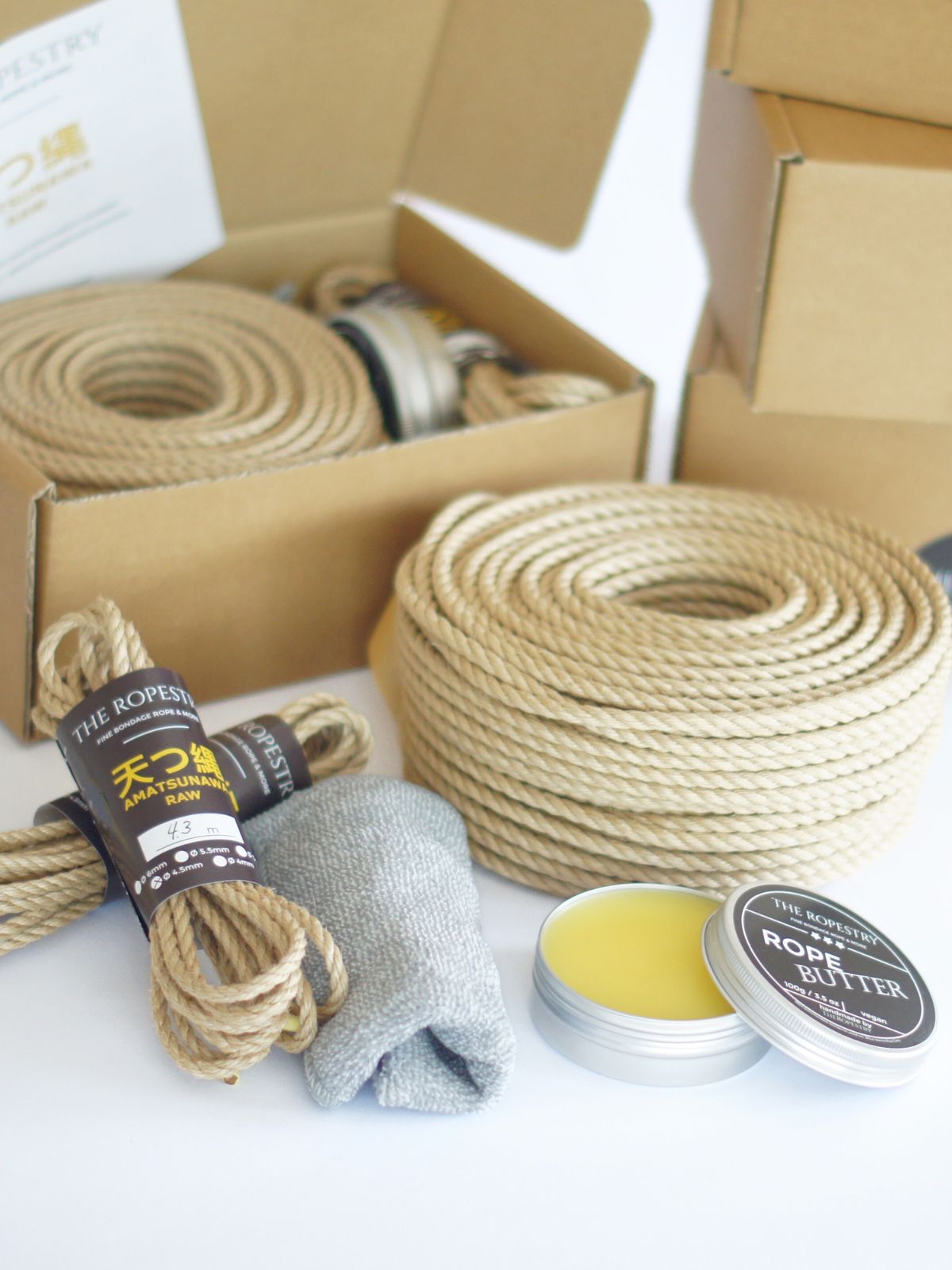
Introducing DIY RAW BOX: The ultimate jute rope conditioning box with a 50 m roll of awesome AMATSUNAWA RAW rope, rope butter and lots, lots more! Are you ready to create your individual rope bondage set with our wonderful JBO-free AMATSUNAWA jute rope? Look no further than our AMATSUNAWA RAW rope — an outstanding and exquisite choice for your sensual and creative bondage projects. Our DIY RAW BOX contains:Three Diameters: Each box includes one 50-meter roll of our popular AMATSUNAWA RAW rope. But that’s not all! The rolls come in three different diameters, allowing you to choose the diameter that suits your rope needs the most.Choose from the following diameters: 6 mm 5.5 mm 5 mm Freedom to Cut & Knot: The DIY RAW ROLL empowers you to cut your ropes directly from the roll, tailoring them to your desired length. Knot the ends, experiment with different knot types or colourful whippings, just let your imagination run wild. Hold Wrists or Ankles in Place: We also include two pieces of thin 4.3 m long jute ropes to attach wrists or ankles quickly. Here you can choose from two diameters: 4.5 mm 4 mmFinest Vegan Rope Care Butter: Right next to the ropes you will find a full 100 g / 3.5 oz plastic pot (NEW!) of our awesome vegan rope butter essential to DIY condition your ropes. Our rope butter is made from Jojoba oil and Mokurō wax and gives your ropes a subtle shine without making them greasy.FREE COMPLIMENTARY Microfiber Cleaning Cloth: A practical tool that wipes away flaming dust or dirt effortlessly! We roll it up neatly and add it to your box!Robust Storage Box: Our practical storage box not only keeps your rope organized but also safe from dirt, dust and direct sunlight. Brochure with Easy-To-Follow instructions: Our box comes also with a delightful surprise. Inside, you’ll find a small, informative brochure with step-by-step instructions for conditioning your ropes. Whether you’re a seasoned Shibari master or a curious beginner, these tips will ensure your ropes stay in top shape.Illustrated Inspiration: Flip through the brochure to discover illustrated guides for creating a crown knot and other nifty tricks. We believe that caring for your ropes is an art in itself, and we’re here to guide you every step of the way.Ready to Unleash Your Rope Skills? If you haven’t experienced our AMATSUNAWA rope yet, now’s the perfect time. Dive into a world of natural premium jute, impeccable quality, and endless possibilities. Explore our rope sets, butter and accessories and let your imagination soar! Find out more about our AMATSUNAWA rope here: AMATSUNAWA created this luxury Asanawa to provide you with the perfect tool for your tying pleasure. Sourcing premium quality Tossa jute batched using soybean oil and twisted with a technique to significantly reduce hair and fibre loss into a single–ply yarn. The yarn is food-grade and specifically developed for prolonged skin contact. Yarns are wound for softness and stability by our Japanese partner to produce a superior rope.JBO-FREE - SKIN-FRIENDLY - BIODEGRADABLE Materials used:Jute yarn: 100% corchorus olitorius TossaBatching oil: Soybean oil Japanese production. Product ships from Germany. Important information about the product: Yarn spools are not infinitely long. Each spool of yarn has a beginning and an end, representing joins in the rope made with a reef knot. We recommend customers to remove these knots if possible. Further detailed product safety and usage guidelines for our products can be found here.


A high-quality Shibari blindfold crafted from premium cotton satin, featuring a dense floral all-over print of rich orange-red poppies against a deep black base. Made up from 3 layers of fabric, it has a pleasantly cool, silky-smooth surface and a luxurious soft feel against the skin. It is exceptionally grippy, shape-retaining, and completely opaque – perfect for sensual and intimate moments. Whether as an elegant accessory or for your next Shibari or bondage session: Our blindfold "Poppy Flowers" combines aesthetics, quality, and functionality at the highest level. With a generous length of 110 cm (approx. 43.3"), you can wear it flexibly or tie it classically at the back of the head – entirely according to your personal preference. This allows you to adjust the pressure and fit exactly to your needs. Perfectly suited for sensory deprivation, Shibari sessions, deep meditation, or simply relaxing periods of rest. The mask creates a pleasant darkness and a wonderful feeling of inner serenity. Product Details:Material: 100% finely woven cotton – breathable, skin-friendly, and shape-retaining. Construction: 3-ply (three layers of fabric) for optimal opacity, grip, and comfort. Wearing Style: Can be worn flexibly or tied classically at the back of the head – for individual adjustment of pressure and fit. Light Protection: High weave density of the fabric combined with the 3-layer construction ensures excellent light shielding. Workmanship: Precise seams and a robust fabric structure for a long service life, even with frequent use. Pattern/Print: The print placement varies from piece to piece; each item is unique. Product Data & Dimensions:Dimensions: approx. 110 × 12 cm (approx. 43.3" × 4.7") Care: Machine wash at 30 °C (86 °F) Feel: Smooth, densely woven, lightweight yet grippy fabric – opaque and high-quality. Design: floral "Poppy Flowers" allover print design. Handcrafted with care. A great gift for lovers of Shibari, sensory play, meditation, or anyone who values high-quality blindfolds. Detailed product saftey and usage guidelines for our products can be found here.


Shibari Starter Kit – Limited Edition Looking for a clear and practical introduction to Shibari? This limited Edition Starter Kit contains all the essentials for your first bondage sessions. Set Contents: 2 × KIYOMI Premium Jute Rope Ø 5.5 mm × 4 m (untreated)2 × KIYOMI premium jute rope Ø 5.5 mm × 8 m (untreated)1 × Scented Rope Butter Strawberry (50 g)1 × 3-ply handmade blindfold made of printed cotton satin (110 × 12 cm)1 × conditioning instructions The Kiyomi ropes are made of high-quality, JBO-free jute with a medium-tight lay. The 5.5 mm diameter feels comfortable in the hand and is suitable for quick ties as well as chest and hip bondage. The 4 m ropes work well for arms and legs, while the 8 m ropes are ideal for more elaborate ties around the body. The ropes are untreated and can be conditioned with the included strawberry-scented rope butter. We include instructions for conditioning with every set. The Rope Butter with strawberry scent conditions your ropes, keeps them supple and adds a light, pleasant fragrance. It nourishes the fibres and helps extend their lifespan. The blindfold is triple-layered and fully opaque. It is made of soft cotton satin with a floral print on black and measures 110 × 12 cm (43.3in x 4.7in). Print placement varies from blindfold to blindfold – each piece is therefore an unique item. This Shibari set has been compiled specifically for beginners. The rope lengths are versatile and the materials are skin-friendly and easy to handle. Limited Edition – while stocks last. Order your Shibari Starter Kit now and begin your rope journey! JBO-FREE ROPE - SKIN-FRIENDLY - BIODEGRADABLE Materials used: Jute yarn: 100% corchorus olitorius TossaBatching oil: Soybean oilProduct ships from Germany. Important information about the product: Yarn spools are not infinitely long. Each spool of yarn has a beginning and an end, representing joins in the rope made with a reef knot. We recommend customers to remove these knots if possible.Further detailed product safety and usage guidelines for our products can be found here.

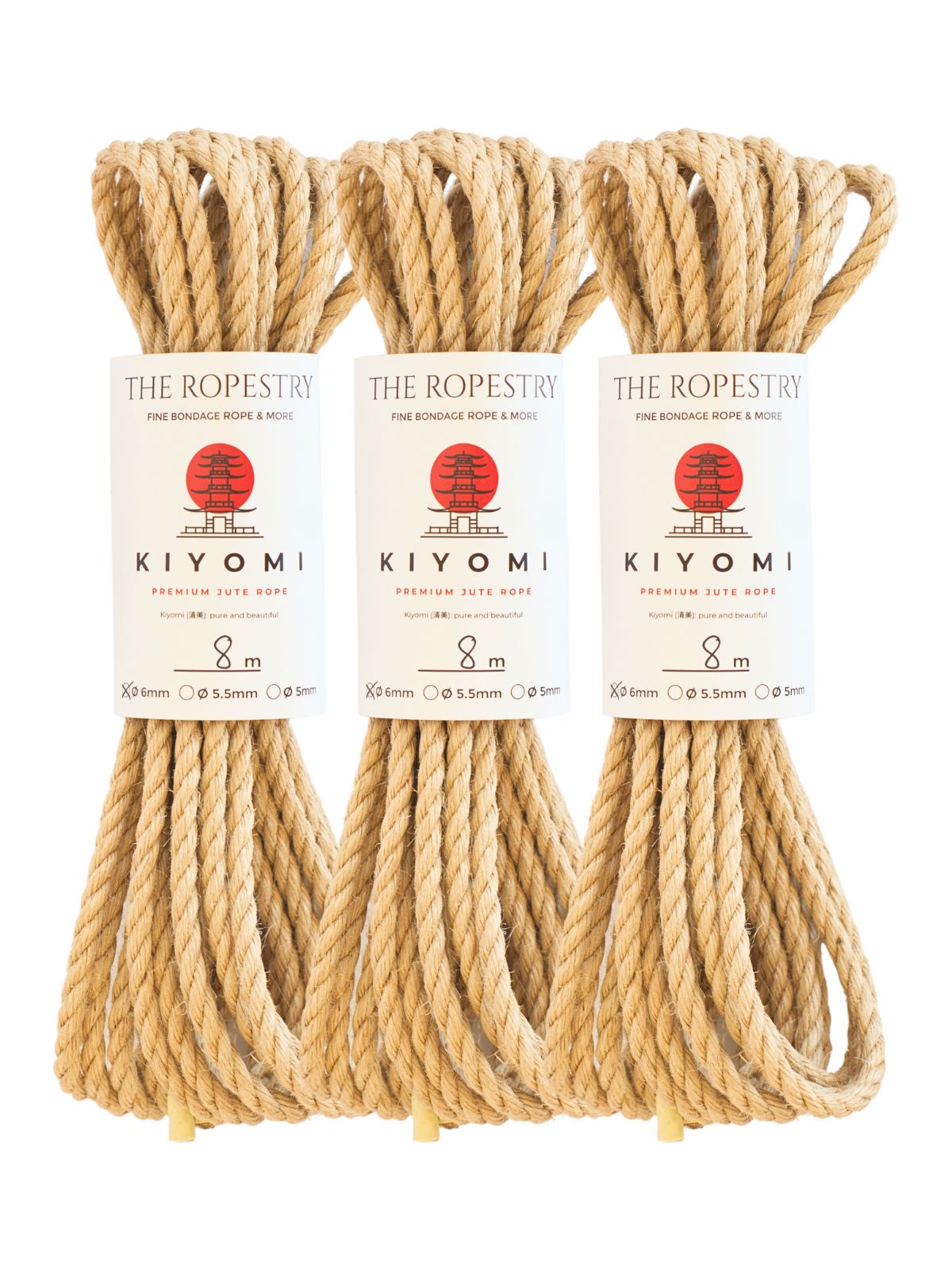
Shibari Set “Upline Ready” – Suspension Starter | 1× 16 m + 2× 10 m + 3× 8 m KIYOMI 6 mm + Rope Oil + Rope Bag Your curated entry into longer ropes and first suspension work. The “Upline Ready” Set is designed for everyone who wants to move beyond classic floor work and start working with longer, stable 6 mm ropes. At the centre is a 16 m KIYOMI 6 mm rope – ideal for the classic Takate Kote (chest harness). It is complemented by two 10 m and three 8 m ropes that work excellently as uplines as well as for additional harnesses and more complicate ties. This gives you enough material for more elaborate designs and your first suspensions. All ropes are untreated KIYOMI 6/0 – our strong, medium-lay all-rounder rope made from high-quality Tossa jute. It is JBO-free, skin-friendly and specifically developed for prolonged skin contact. With a breaking load of ~230 daN, the 6 mm KIYOMI offers high strength and is therefore also suitable for suspension work. The ropes need to be conditioned before first use. For the actual conditioning process we recommend our different rope butter variants. The included 100 ml Premium Jojoba Rope Oil is ideal for regular after-use care and ongoing rope maintenance. Contents of the “Upline Ready” Set: 1 × 16 m KIYOMI 6/0 (Ø 6 mm) – Ideal for the Takate Kote (chest harness) and other longer structures. Untreated. Breaking load: 230 daN. 2 × 10 m KIYOMI 6/0 (Ø 6 mm) – Excellent as uplines as well as for longer runs and stable builds. Untreated. Breaking load: 230 daN. 3 × 8 m KIYOMI 6/0 (Ø 6 mm) – The classic standard length – usable as uplines, for harnesses, body wraps and floor work. Untreated. Breaking load: 230 daN. 1 × 100 ml Premium Jojoba Rope Oil – For regular after-use care and ongoing rope maintenance. 1 × Rope bag – Practical storage and transport (included in the promotional price). 1 × Step-by-step rope conditioning guide 1 × Flyer with illustrated instructions for the crown knot Why this set? This set deliberately focuses on exclusively 6 mm KIYOMI ropes – strong, grippy and suitable for suspension. With a breaking load of ~230 daN, the material offers a high level of safety for load-bearing applications. The 16 m rope is specifically designed for the Takate Kote, while the 10 m and 8 m ropes can be used flexibly as uplines and all-rounders. This provides sufficient rope volume for first suspensions as well as for advanced floor work. The set is completed by rope oil for regular care and a practical rope bag. A step-by-step conditioning guide and a flyer with illustrated instructions for the crown knot are included in the package. All ropes are 100 % chemical-free, sustainable and biodegradable. Ideal for anyone who wants to take the next step towards suspension – without compromising on quality or materials. Experience the diversity of TheRopestry. JBO-FREE ROPE - SKIN-FRIENDLY - BIODEGRADABLE Product ships from Germany. Important information about the product: Yarn spools are not infinitely long. Each spool of yarn has a beginning and an end, representing joins in the rope made with a reef knot. We recommend customers to remove these knots if possible.Further detailed product safety and usage guidelines for our products can be found here.